
In today’s evolving CX world, customer service teams are under constant pressure to resolve issues faster while managing a growing volume of requests. To keep up with these demands, many organizations have turned to AI-powered tools. In fact, there’s a good chance you already use Generative AI in your work or even in your daily life.
But what does this look like in practice?
Consider this common scenario: A customer reaches out to a customer service support team asking why their order hasn’t arrived.
With the help of Generative AI, the system drafts a response explaining possible shipping delays and summarizes the customer’s message so the agent can quickly understand the issue. The agent then reviews the information, checks the order status, and determines the appropriate resolution for the customer.
While Generative AI has already transformed many organizations, the next evolution in technology is Agentic AI, designed to identify problems, take action, and drive resolution actively.
CX leaders can’t ignore this shift from Generative AI to Agentic AI.
The rise of Generative AI
According to organizations such as the National Institutes of Health and IBM, generative AI refers to a class of algorithms and models that produce new content, including text, images, videos, or software code in response to user prompts, showing human-like creativity and adaptability.
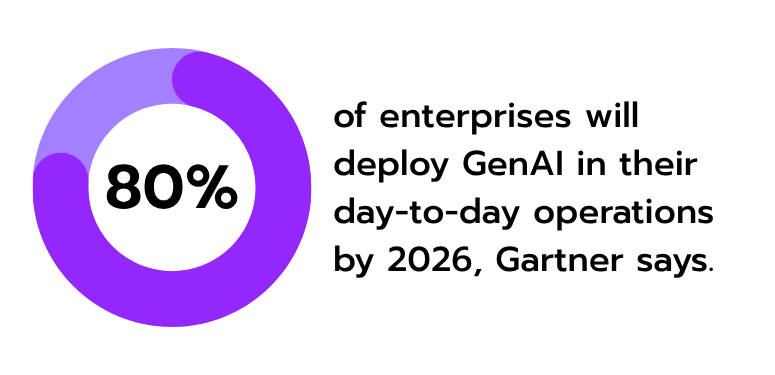
Since GenAI exponentially increases the work a person can do, it’s no surprise that adoption has surged. Many companies have already embedded generative AI into their workflows or are in the process of doing so, with industry analysts projecting that over 80% of enterprises will deploy GenAI in their day-to-day operations by 2026.
Even though this recent surge in popularity can make Generative AI feel like a new technology, its foundation goes back further. In fact, early forms of generative systems date back to the 1950s, when rule-based programs were first developed by humans.
These systems formed the foundation of the GenAI we know today.
From the 1950s until now, Generative AI has introduced significant changes to how CX organizations manage customer interactions. In contact centers, Gen AI is used to support agents by summarizing customer conversations, drafting suggested responses, generating knowledge insights, etc. All these capabilities help agents use their time efficiently and improve consistent communication with customers.
These innovations have been nothing short of revolutionary for customer experience. However, as businesses continue to scale out their operations, there are limitations to GenAI that have become more apparent.
Introducing Agentic AI
While generative AI transforms customer experience, its role is largely reactive. Agentic AI represents the next evolution: systems that don’t just respond but take action. According to Amazon Web Services, agentic AI is an autonomous AI system that can act independently to achieve pre-determined goals.
An AI agent is capable of making independent contextual decisions without the constant need for human oversight. Instead of waiting for instructions at every step, it operates with a defined objective and determines how to achieve it.
In a CX context, this means moving from isolated interactions to end-to-end results.
This evolution is powered by a continuous intelligence loop, where Agentic AI moves through 4 key stages:
- It perceives by continuously gathering and interpreting data from its environment, systems, and user interactions.
- It reasons by analyzing that information, identifying patterns, and determining the best course of action based on goals.
- It acts by autonomously executing tasks, making decisions, and interacting with systems to achieve outcomes.
- It learns by using feedback and results to improve future performance, becoming more effective over time.
Going back to our example from above, consider the same scenario handled differently:
Instead of directing the issue to a human agent and providing the agent with a summary of the issue, an agentic AI assistant communicates directly with a customer, detects the order delay, checks the status, and notifies the customer with an updated delivery estimate. All without requiring a human agent to step in.
Generative AI vs Agentic AI
While both artificial intelligence systems play a critical role in modern CX strategies, they operate at fundamentally different layers. Generative AI focuses on creation while agentic AI, on the other hand, focuses on execution. It moves beyond generating outputs to completing tasks, making context-related decisions, and driving workflows to resolutions.
These capabilities unlock a new level of efficiency and consistency across customer journeys. By taking on structured, high-volume tasks, AI allows human agents to focus on emotion-driven moments that require human judgment and relationship-building. For CX leaders, this impact means faster resolution times, improved first contact resolution, and lower operational costs. Likewise, experiences become more seamless; agents no longer need to navigate multiple screens or complex systems to help customers, and customers benefit from an empathetic, enjoyable experience.
-2.png?width=1200&height=853&name=Comparison%20table%20generative%20AI%20vs%20Agentic%20AI%20(2)-2.png) According to Amazon Web Services, moving to an agentic AI workflow will benefit businesses by:
According to Amazon Web Services, moving to an agentic AI workflow will benefit businesses by:
- Increasing efficiency
- Increasing customers’ trust
- Augmenting human skills
- Continuous AI improvement
By combining autonomous execution with human oversight, organizations can move from reactive support models to more intelligent, proactive service.
This evolution raises a critical question: What’s the next step for AI in CX?
With AI maturity, the customer experience will undergo a shift defined by autonomy and tighter integration across the entire customer journey. The move is about building AI-driven ecosystems that can anticipate needs, make decisions, and continuously optimize experiences in real time.
The next step for AI in CX will be moving towards anticipatory CX, where AI will identify behavioral patterns, sentiment changes, and usage trends to act before problems arise.
At the same time, we’re seeing a stronger emphasis on orchestration across channels and systems. Future AI models won’t operate in silos; they will coordinate across CRM platforms, communication channels, and internal workflows to deliver seamless, consistent experiences.
As AI becomes more embedded in decision-making, governance and trust will be the critical differentiators. Organizations will need to establish clear boundaries to ensure transparency in AI-driven actions and maintain humans in the loop where it matters most. As explored in our blog, “Trust: The new currency for customer loyalty,” the ability to build trust and maintain it will define which businesses successfully scale AI in their CX strategies.
Finally, the role of human agents will continue to evolve, where rather than AI replacing customer service agents, they will become experience orchestrators. In these roles, they will step into their emotional intelligence, complex judgment, and relationship-building skills.
For a deeper look at the trends already shaping this transformation, including key insights every CX leader should be paying attention to explore our eBook “The State of AI in Customer Experience 2026”