

As customer expectations for personalized, instant experiences rise, call centers are under increasing pressure to modernize by leveraging AI. What began with generative AI is now being replaced by agentic AI, which is capable of autonomously taking action to solve customer issues and inquiries.
It’s no surprise that many people are beginning to fear how emerging technologies will affect their jobs and whether automation will replace them. Across call centers, agents are being asked to work alongside AI tools without guidance on where AI’s role stops and their roles begin.
Under these circumstances, it’s natural for many people to ask a difficult question: What does this mean for the human agent?
In 2025, AI has already been linked to at least 55,000 layoffs in the U.S., signaling that automation is no longer a distant possibility. For many customer experience (CX) organizations, announcements like this reinforced a growing perception that AI is replacing service and affecting job security.
However, raw layoff numbers can’t tell the full story. What we’re witnessing today is the workforce undergoing a major transformation where technology reduces the need for certain positions but opens new opportunities for growth.
Looking at AI from this perspective, the more important question for CX leaders should be: Are we redesigning the contact center intentionally, or letting cost-saving benefits define the strategy?
The future of CX won’t be automated alone; it will be shaped by how effectively organizations balance the use of AI with the human touch that brings trust, empathy, and human judgment.
AI eliminates friction, not the need for humans
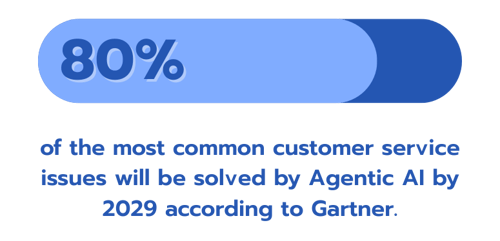
Gartner found that 80% of the most common customer service issues will be solved by Agentic AI by 2029. Simple, quick inquiries like password resets or balance checks will be handled by AI bots, as will call routing or initial account verifications. What’s getting replaced is the manual effort and administrative tasks that take up a large chunk of agents’ time.
More complex issues will still be elevated to human agents; however, customer verification will take less time with AI handling initial data gathering. This will greatly reduce friction and lower costs.
AI is meant to eliminate inefficiency and easy but common interactions because the emotional connection still belongs to the people. As Pasquale DeMaio, VP of Amazon Connect, shared on Amazon Business Radio, the most effective approach is “better together,” where humans and AI complement each other.
This perspective reinforces an important shift: AI is redefining the nature of jobs. Applying AI effectively, as DeMaio emphasizes, is about choosing the right solution for each problem. Some interactions are best handled by automation for speed and efficacy; others require human understanding and adaptability.
Why is the nature of jobs changing?
There are three key drivers behind this shift:
1. Automation is taking over routine work
AI excels with repetitive, rules-based tasks and carries on with consistency. AI-powered chatbots and virtual assistants can handle common customers’ inquiries such as passwords resets or order status. This automation has the goal of reducing or eliminating these tasks completely off the agent’s workload.
Agents can then focus on handling the more complex, emotionally charged interactions that AI can’t solve and provide a stellar customer experience.
2. Customer expectations are increasing
Customers' expectations grow by the minute; they expect fast, accurate, and personalized interactions across channels. They don’t want to repeat themselves when moving from chat to voice, and they expect rapid resolution to their problems.
AI can gather basic customer account info, verify customer identity in low-risk scenarios, and gather context for agents. It can also walk agents through the steps needed to resolve customer inquiries. This way, agents enter conversations empowered with the info they need to resolve customer issues quickly.
When agents and AI work together, agents and customers both have better experiences.
3. Organizations are measuring different outcomes
The efficiency that AI brings to an organization has a structural consequence in managing CX. Many contact centers continue to use legacy metrics designed for high-volume, including Average Handle Time (AHT), Call Volume, and Cost per Contact. As contact centers evolve, performance metrics also shift to outcome-based metrics like Self-Service Rate, Customer Satisfaction, and Net Retainment Rate.
These new success metrics measure agents who can build rapport, understand context, and deliver resolution in ways machines can’t. For CX leaders, this is a pivotal moment because when simple work disappears, excellence is no longer optional; it becomes the standard.
The shift CX leaders must take
This evolution demands leaders to rethink how jobs are designed, measured, and supported by:
-
Shifting to experience quality metrics
-
Encouraging experimentation and continuous improvement on AI workflows
-
Empowering agents to go beyond scripts
-
Investing in human skills that machines cannot replicate
Differentiating by providing personalized and proactive support, building emotional loyalty, using customer data to anticipate needs, and solving complex problems others can’t.
When leaders embrace this shift, the contact center becomes less about handling volume and more about creating value. These changes in an organization send a powerful message: agents are being repositioned, not replaced.
So, is AI actually replacing agents?
An honest answer? In some organizations, roles will be reduced. Cost pressures are becoming real, and automation can provide a solution by handling common but easy to resolve customer inquiries.
However, AI will likely never systematically replace all customer service agents. It will fundamentally change what types of tasks agents handle and will accelerate the pace at which customers reach resolutions. But if complex reasons for customer contacts exist, so will the need for humans to resolve them.
What should agents do? Focus on what automation cannot replicate: navigate ambiguity, build trust, retain at-risk customers, and strengthen your empathy skills. Agents who learn to leverage AI and work with it, not against it, will be more efficient and stand out to leaders.
The future of CX will not be fully autonomous; it will be AI-augmented led by humans. In that model, the most successful organizations won’t be those that get rid of their agents; it’s those that empower them most effectively.
If you’re curious about how automation is impacting contact centers in 2026, download our most recent eBook “The State of AI in CX 2026” where you’ll find 5 critical findings that are impacting the CX journey and practical frameworks to resolve them.