

In the rush to modernize customer experience and catch up with technology advancements, organizations have raced to implement AI point solutions to solve immediate problems.
Individually these tools solve tasks; collectively, they generate fragmented tools and mountains of data. Now, we’re seeing an ecosystem that fails to deliver seamless customer experience (CX) journeys and business value.
In 2026, CX leaders face new realities that demand strategic, human-centric, and integrated approaches.
The challenge is no longer whether you should implement AI solutions: it’s making existing technologies work in tandem and drive real business results.
Based on what we’re seeing across the CX landscape, here are 5 critical AI findings that are defining the next phase of the CX journey.
To help leaders navigate these challenges, we’ve also compiled an in-depth e-book in The State of AI in Customer Experience 2026 that explores each finding and provides practical frameworks to resolve them.
1. Adoption Saturation
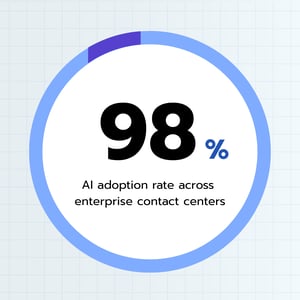 While 98% of organizations use AI, only 12% claim to have "fully optimized" its value. The rest are stuck in pilot purgatory, unsure how to use AI to its full potential.
Agents toggle between platforms and struggle to integrate AI insights into their conversations, and leadership struggles to adopt complicated AI tools. This discrepancy is called The Strategic Gap. When AI is hard to use or can’t be tied to value, people won’t use it.
CX leaders must prioritize tool consolidation and strategic adoption with applications that have proven their worth. These include transactional AI chatbots, real-time analytics, and agent assistance tools. In 2026, focus on simplification, not expansion. Better integrated tools will deliver more impact than an overload of dashboards, data, and tools.
2. The Human Premium
Automation has transformed customer service, but the human element remains the differentiator. In fact, as AI handles more routine tasks, human interactions carry more weight than ever. The most successful companies in 2026 are those that invest in human-AI collaboration because empathy is now a premium commodity that customers value even more.
Customers crave understanding, empathy during complex situations, context-aware conversations, and fast resolutions without being transferred repeatedly.
These expectations create what we call the human premium, which is the increasing value of empowered agents who are skilled in negotiation, emotional intelligence, and tech troubleshooting.
In 2026, technology should supplement human expertise, not compete with it. CX leaders who prioritize agent experience (AX) see stronger customer satisfaction and loyalty in return.
3. Data Paralysis
With AI, leaders now have access to all the data they could ever want from metadata, handle times, transcripts, survey responses, etc. Yet many organizations are overwhelmed, struggling to turn that mountain of data into action.
Contact center software automatically calculates metrics like average handle time, first call resolution rate, and sentiment. What matters more than having this data is being able to do something about it. 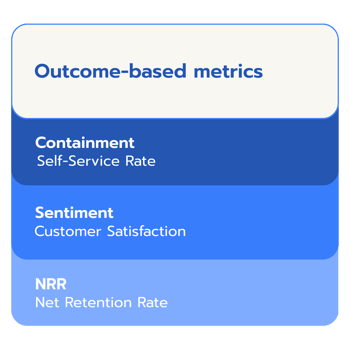
Leaders must learn to drill down into data, understand root causes, and quickly implement changes to improve CX. Invest in software that moves beyond data to provide insights, like customer intent, and that creates agent training suggestions from these insights.
By focusing on the “why?” and the “what do I do next?” Instead of the raw data, you can quickly see the business value of any AI investments.
4. The Trust Deficit
In an era where data breaches and deepfakes are so common, trust has emerged as the main core CX metric.
It starts internally: agents and leaders need confidence that AI systems are governed, regulated, and ethical.
If agents trust AI agent assist tools and see how these tools can make their lives easier, they will be more likely to use them confidently. When customers sense this confidence, through consistent and transparent interactions, trust deepens.
Leaders need to develop a purposeful AI strategy and communicate it across the company, ensuring agents understand how AI benefits them.
On the flipside, even when CX leaders want to use AI, customers don’t always want to talk to AI. Many organizations have damaged the trust between AI and its customers by deploying deflection strategies disguised as self-service. This increases customer frustration and leads to customers' annoyance every time they have to interact with AI.
The simple solution? Organizations must be intentional when building self-service to actually resolve issues. Not only that, but customers want transparency; they want to know when they’re interacting with AI, how their data is being used, and how decisions are made.
Building trust is a CX strategy that organizations need to reduce risks and strengthen customer relationships.
5. The Agentic Shift
The final insight of reshaping CX is the shift from Generative AI to agentic systems.
Unlike GenAI, which generates text or images based on specific prompts, Agentic AI has the authority to perform tasks. Beyond that, Agentic AI identifies intent, root cause, trigger workflows across systems, and resolves issues end-to-end with human oversight.
This shift frees agents from repetitive-decision making tasks, and allows them to focus on complex problem solving, emotional intelligence, and relationship building.
Agentic systems reduce the need for constant manual intervention and allow leaders to move toward strategic CX design. This shift restores balance by handling execution at scale.
Bring it all together
In 2026, CX success is about addressing the structural challenges created by years of adoption saturation, data paralysis, trust deficit, and following the rise of agentic AI and the human premium. Organizations that confront these realities head-on are better positioned to improve CX metrics, empower agents, and deliver long-term business value.
For more critical findings on AI in CX, download the full 27-page report “The State of AI in CX 2026.” It’s what every CX and contact center leader needs to intentionally build a seamless, human-centric CX strategy.