

AI CONTACT EXPLORER
Monitor + Tune Every Agentic AI Bot Conversation in Your Contact Center
Customers don't hate AI — they hate bad experiences. AI Contact Explorer (ACE) audits 100% of your agentic AI voice and digital bot interactions on Amazon Connect Customer, automatically detecting hallucinations, business process failures, customer frustration, and transfers to live agents so your team can fix issues before customers ever feel them.
THE AI BLIND SPOT
Agentic AI is scaling faster than anyone can monitor it
The rush to deploy agentic bots has outpaced the ability to audit what they actually do — and customers are already telling researchers how that's going.
59%
of consumers say AI agents are frustrating to deal with.
Source: AnswerConnect / OnePoll survey of 6,000 consumers, April 2026
$3T
in global revenue is at risk from poor customer experiences every year.
Source: AmplifAI, Customer Service Statistics 2026
~1 in 5
consumers who used AI customer service report 0 benefit from the experience.
Source: Qualtrics XM Institute, 2026 Consumer Experience Trends Report
Only 14%
of self-service interactions fully resolve the customer's issue.
Source: Gartner
The data is clear: if you don't know what is happening with your agentic bots, it is costing you.
BEYOND TRADITIONAL BOT AUDITING
Six questions AI Contact Explorer answers about your agentic AI bots
Traditional QA samples a handful of calls a month. ACE reads 100% of interactions and turns them into answers your team can act on today.
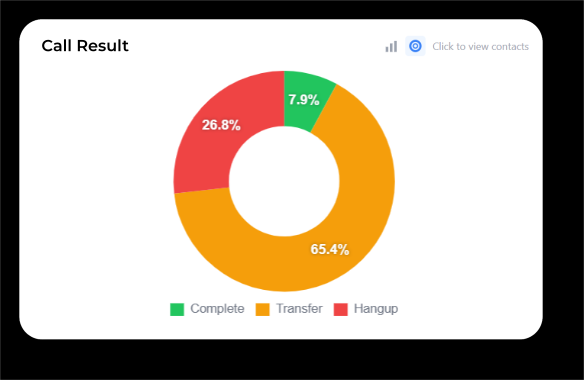
INTENT PERFORMANCE
Which intents are your bots handling well?
Monitor critical customer intents in self-service
Increase call containment
Improve CSAT
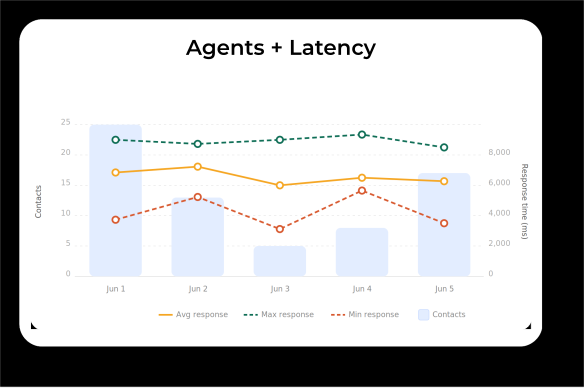
RESPONSE SPEED
Are your agentic AI bots fast and responsive?
Find and correct latency in responses
Fix sluggish integrations
Improve CSAT
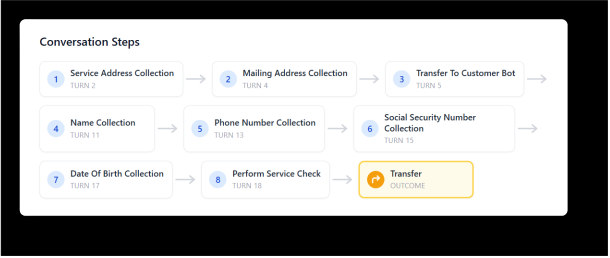
FAILURE POINTS
Where do bots fail and transfer to live agents?
Tune problematic turns
Pinpoint negative experiences
Find business process gaps
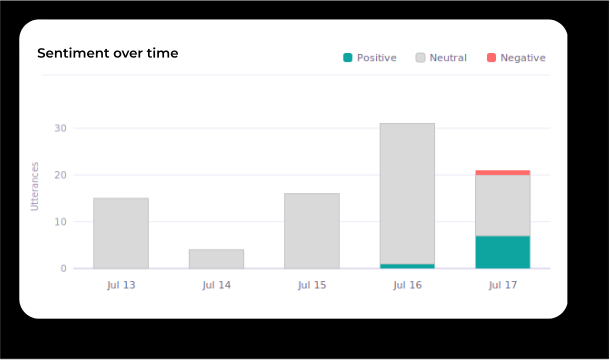
EXPERIENCE OVER TIME
Are bots improving customer experience?
Are bots improving customer experience?
Improve CSAT by monitoring sentiment
Track CSAT across new bot versions
HALLUCINATION DETECTION
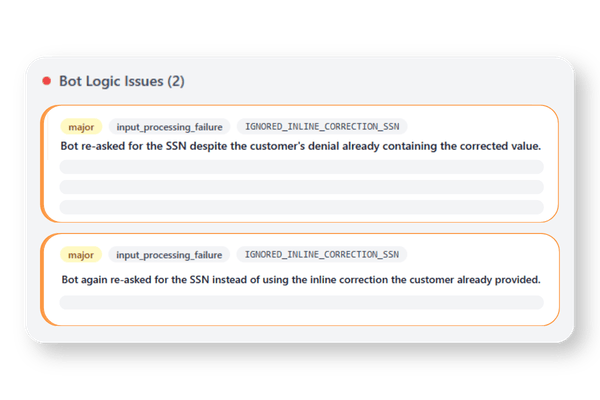
How can I detect hallucinations in agentic AI bots and monitor performance after new releases?
Monitor 100% of interactions against business rules
Deploy corrections and track performance release over release
Compare results across LLM, speech, and text models
ISSUE PRIORITIZATION
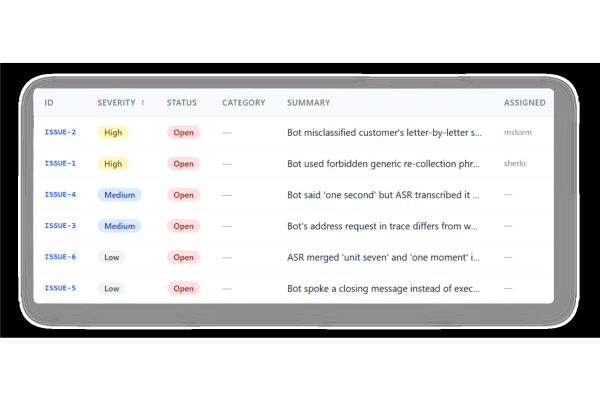
How do you prioritize what bots get wrong?
Log issues by severity
Assign issues to business, IT, or USAN's AI experts
Fix what's driving negative experiences
Analyze every agentic voice and digital conversation
Detect issues and hallucinations
Rank issues by severity and business impact
Tune and improve your bots
Release new versions and monitor results
Explorer
HOW IT WORKS
Continuously improve your agentic AI customer experience bots
ACE isn't a one-time audit — it's a continuous loop. Every conversation feeds the next release, so your customer experience bots get measurably better each time you ship.
Higher resolutions & containment
Lower escalations & transfers
Fewer hallucinations
Higher CSAT & better outcomes

Ready to gain oversight into your agentic AI bots and start designing bots that will actually resolve customer inquiries?
Schedule time with our CX experts today to get started now.
FAQs
1. What is a contact center solution, and how does it improve customer experience?
A contact center solution integrates your phone, chat, email, routing, and data reporting into a single platform. This setup gives agents a clear, real-time heads-up on a customer's history and reason for calling. By removing the guesswork, agents can solve problems faster and deliver a seamless experience across every channel.
2. What are the key components of a successful contact center strategy?
A successful strategy relies on three interconnected pillars. First is smart call routing tailored to how your business actually runs. Second is deep reporting that catches technical bottlenecks early. Third is tight CRM integration so agents have customer data instantly.
3. What are the benefits of a cloud-based contact center?
Moving to a cloud based contact center is all about speed and flexibility. It also eliminates vendor delays - complex IVR adjustments that used to take weeks can now be built, tested, and deployed efficiently.
4. What features should I look for in a cloud contact center solution?
Features such as configurable routing, omnichannel support, CRM integrations, analytics, reporting, self-service automation, security controls, and scalability.
5. What is the best way to migrate to a cloud contact center?
The best migration approach is phased and well planned, running both systems parallelly and with staged traffic movements. Performance validation before retiring the legacy system until the new system proves itself is also vital.
6. What is omnichannel customer service, and why is it important?
Omnichannel customer service connects interactions across multiple channels. It helps customers move from chat to phone or email while agents maintain access to the full conversation history.
7. How do contact center solutions support voice, chat, email, SMS, and social media?
Contact center solutions route interactions across multiple channels through a centralized system.
8. What role does analytics play in improving customer service?
A human QA team can only listen to a tiny fraction of calls manually, meaning important trends or issues can take weeks to notice. Conversational analytics software reviews 100% of your interactions instantly. It catches rising problems and customer frustrations right as they happen.
9. How do managed services improve contact center performance over time?
Managed services improve performance through ongoing monitoring, support, optimization, and performance review. They help keep routing, workflows, automation, and reporting aligned with business goals.
10. What ongoing support should a contact center provider offer?
A contact center provider should offer monitoring, issue resolution, optimization, routing updates, integration support, reporting review, and guidance on new features post launch.
11. What industries benefit the most from modern contact center solutions?
Industries with high-volume or compliance-sensitive customer interactions benefit from cloud contact center solutions. Based on customer service needs, these include healthcare, finance services, utilities, retail and travel industries.
12. What strategies improve customer satisfaction in a contact center?
Customer satisfaction improves through better routing, fewer transfers, stronger agent context, self-service options, sentiment monitoring, and issue resolution before problems escalate.
13. How can businesses deliver consistent customer support across every channel?
True consistency relies on a shared history. Consistency happens when you run everything through a single, unified system so your agents always have the full customer journey right in front of them.
14. Can a contact center solution integrate with Salesforce or Microsoft Dynamics?
Yes, Salesforce often connects through Service Cloud Voice for the deepest integration. Dynamics usually runs through a CTI setup that keeps a customer's record open in the same screen as the call.
15. How do contact center solutions help businesses scale customer support?
A major seasonal spike can be absorbed through a quick configuration update rather than a costly hardware purchase order. Once the rush passes, your capacity drops right back down automatically - meaning you only pay for what you actually used, with no expensive, leftover equipment sitting idle.